Product Overview
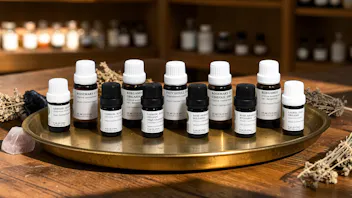
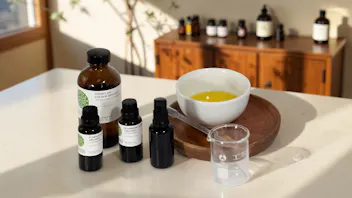
Our Benzoin has a rich, intensely sweet, warm, powdery, balsamic, vanilla-like aroma, with a subtle spicy/cinnamon-like undertone. It is an effective fixative for the middle notes of perfume compositions, soaps, cosmetics and toiletries,[1],[2] while the raw material is used extensively in the manufacture of incense.[3] It is worthwhile to note that the addition of too much Benzoin can suppress the odor of other aromatic ingredients.[4] 'Sweet, but not sugary', 'rich but not heavy' are the reasons why perfumers prize Benzoin.[5] Please be aware that because this product is diluted with ethanol, it is not soluble in fixed (carrier/vegetal) oils or in fixed oil-based products.
Benzoin is a resinous tree in the Styracaceae family. The genus Styrax contains about 130 species of trees and shrubs occurring in tropical to temperate climates with three main areas of distribution: southeastern Asia, southeastern North America to South America, and a single species in the Mediterranean.
To harvest Benzoin resin, farmers climb up to a height of 30 feet using rope ladders where an incision is made in the bark to make it 'weep' (release) the gum. After about ten weeks this exudate forms 'tears'. Apparently simple, but physically demanding, this is a skilled technique that will soon be lost, especially as synthetic chemicals replace real Benzoin. When 7-10 years old, one tree can provide an average of up to 0.5 kilo of resin per year. As it is, the yield is very low - 1.2 kilos of tears make 1 kilo of Benzoin resinoid.[6]
PLEASE NOTE: Benzoin dilution in ethanol (30% ethanol, 70% Benzoin resin) is not soluble in fixed (carrier/vegetal) oils.
1 Lawless, Julia. The Encyclopedia of Essential Oils, 2013, p. 48.
2 Williams, David G. Perfumes of Yesterday, 2004, p. 9.
3 Arctander, Steffen. Perfume and Flavor Materials of Natural Origin, 1960, p. 89.
4 Curtis, Tony and David G. Williams. An Introduction to Perfumery, 2nd ed., 2009, p. 242.
5 Industry communication.
6 Naturals Compendium, International Flavors & Fragrances, 2009, p.24.