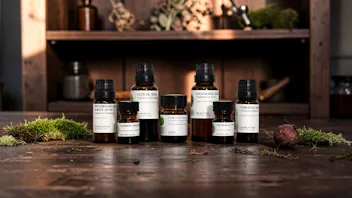
Product Overview
Our organic Melissa has a fresh, lemony, somewhat tart yet sweet, green-herbaceous aroma with subtle notes of mint and honey. Melissa officinalis is a perennial herb that is also known as Balm or Lemon Balm.
This fast-growing plant from the Mint family (Lamiaceae) has small, white flowers abundantly filled with nectar that are especially attractive to bees, thus its name, Melissa – melittena in Greek for 'honey bee'.[1] One source states that the local name for the plant in many countries of central and southern Europe is 'heart's delight'.[2] An exceptionally low yield (about 0.05%) makes Melissa a very costly oil and one that is commonly adulterated with inexpensive oils like Lemongrass, Citronella and Litsea Cubeba.[3],[4] French producers noted that, in 1988, while world production of Melissa oil amounted to no more than 50 pounds, sales of over 1,000 pounds were recorded![5]
There's a gentle power in this unique essential oil, according to Gabriel Mojay, who expounds upon the enlivening lemon-fresh, honey-like sweetness of aroma.[6] Melissa blends particularly well with Bergamot in elevating room sprays, or with Lavender in nighttime linen sprays. A Melissa-Rose (highly diluted) lotion for hand massage is a lovely treat for the elderly.[7]
1 Mojay, Gabriel. Aromatherapy for Healing the Spirit, 1996, p. 96.
2 Arctander, Steffen. Perfume and Flavor Materials of Natural Origin, 1960, p. 411.
3 Lavabre, Marcel. Aromatherapy Workbook, Marcel Lavabre, 1997, pp. 85-6.
4 Arctander, Steffen. Perfume and Flavor Materials of Natural Origin, 1960, pp. 411-412.
5 Lavabre, Marcel. Aromatherapy Workbook, Marcel Lavabre, 1997, p. 86.
6 Mojay, Gabriel. Aromatherapy for Healing the Spirit, 1996, p. 97.
7 Private communication.