7 min read
2017-03-29
Trip to Spain
Written By: Angela Gembrin
Part I
Our week long journey began in Barcelona and took us from the historic region of Catalonia to Valencia, Murcia, Castilla/La Mancha, Andalucía, Estremadura and finally back to the capital city, Madrid -- a drive of nearly 2000 km along the Iberian Peninsula. Spain has a very complex and heterogeneous ecosystem with different climates, topographies and geologies. We experienced a diverse range of landscapes: austere, lunar-like expanses, red, sandy hills, desert areas and forests -- all of which help explain the variety of essential oils found here. We visited a wide spectrum of producers -- from small ones with their rustic stills scattered among the plants, to big, industrial, high tech facilities -- a sort of time travel in the art of distillation.

Within the wide olfactory range available on this land comes one of the most peculiar Spanish plants with an ancient and important identity in perfumery history: Cistus ladaniferus, commonly known as Rock Rose. It grows thoughout the Mediterranean basin, but especially in Spain, Portugal, Greece, Sicily, Morocco, Cyprus and the former Yugoslavia. Today, Spain and Portugal are the main producers of Cistus. In Spain, its harvest and processing is concentrated in the southern region of Andalucía. The botanical name is derived from the ancient Greek: 'kìst(h)os – meaning capsule or basket (referring to the shape of the ripe fruit) and ledanon – resinous exudation- plus the word fero – to bring. Ladaniferus: bearing resin. Its use as an ingredient in ancient perfumery dates back to the second millennium BC[1] and is also mentioned in the Bible[2]. Two distinct aromatic products can be extracted from Cistus ladaniferus: essential oil and Labdanum gum. Cistus essential oil is produced through steam distillation of the leaves and branches while Labdanum essential oil is extracted by steam distillation of the Labdanum oleoresin. Labdanum Absolute and Labdanum Concrete are also obtained by solvent extraction of the oleoresin.
Each flower lasts only one single day...
The plant is a wild and sticky shrub belonging to the Cistaceae family and can reach a height of 8-10 feet. Cistus often appears along the main thoroughfares and you can drive for hours, spotting them on both sides of the road, close to Pines and wild Lavender. The leaves are evergreen and lanceolate, 3-10 cm long. The sticky resin is visible to the unaided eye and really lasts on the hands when you touch it. In the summer, the plant exudes the precious resin to protect itself from the burning sun. The plant is also known as: rockrose3 and labdanum but in Spain it is called jara pringosa, meaning "sticky shrub”.
In April/May the plant blooms with beautiful bowl shaped white flowers (diameter 7-11 cm) with a deep red blotch at the base of each petal. Each flower lasts only one single day! After the summer blooming season, from mid-June to October, the plant is ready to be harvested for extraction of the gum and distillation of the precious oil.
The harvest is done by hand. Workers need to wear protective gloves and everyone has a small sickle to cut the plant. When the plant reaches around 2-3 ft the tops (leaves and branches) are collected and tied into bundles. A good picker can collect around 300kg/660 lbs daily.
Walking in the woods we saw how the plants are irregularly spread here and there. This is probably because it is a very invasive plant colonizer. It can resist low temperatures (to -5 C ̊/23 F.) as well as high temperatures and long dry spells without irrigation. The seeds are contained in a small pod that eventually breaks, freeing the tiny seeds into the air. The seeds can wait up to 20 years for the perfect conditions to germinate! Cistus is a self-pollinating plant which attracts a wide array of wildlife. The number of seeds collected in a dried pod can range from 100 - 1200.
Life isn’t easy for Cistus. We encountered areas with both tall, old shrubs and new baby sprouts reclaiming their territory. They have to tolerate goats and deer who love to eat them. The famous Greek historian Erodoto[4] reported that the goats are accustomed to browsing for Cistus and the best way to harvest the precious resin is to comb through their beards and coats![5]
A barrel of dark brown Labdanum gum is ready to be processed for the extraction of the Concrete and the Absolute. As usual, words are never sufficient for describing a complex olfactory experience. However, Labdanum is often described as amber, animalic, full-bodied, woody, sweet, leathery and warm.
Before reaching the Southern part of Spain we passed through the mountainous slopes of the Sierra Nevadas and the vast and semi-desert plateau of the Meseta. Here we had the opportunity to “meet” some of the queens of Spanish aromatic plants in their natural habitat: Spanish Sage, many varieties of Thyme, Lavender and Rosemary.
Spanish Sage is the common name of Salvia lavandulifolia, also known as Lavender Sage.. It is a small perennial shrub of the Lamiaceae family, somewhat similar to Salvia officinalis but with narrower leaves and small purple flowers.
Spanish Sage very often grows together with Rosemary. Spanish Rosemary, Rosmarinus officinalis ct. camphor, is the most camphorous of the Rosemary chemotypes with a potent, balsamic fragrance and a fresh and clean character[8].
We saw cultivated Rosemarys as well as wild ones. Wild plants collection requires a lot of workers and hard labor, and this year the crop wasn’t up to par due to very dry weather conditions. When a wild Rosemary plant is cut, it needs to recover for 5-6 years before a second harvest is possible. This is why a huge amount of land is required when working with wild plants. Rotational harvests preserve the natural balance of the ecosystem. The producer we visited here works an area of 7000 hectares (approx. 17,000 acres) for collecting wild Rosemary! The yield is influenced by the age of the plant and by weather conditions, among other factors.
We were so lucky to enjoy a full wild Rosemary distillation cycle. What an honor and pleasure for all our senses!
Footnotes
1 Its name reveals connections also with different languages: ladunu in Assyrian, ladhan in Arabic. From, The perfume of Cyprus – from the Bronze age to François Coty – Maria Rosaria Bengiorno, Gangemi Editor.
2 Genesis 37:25 "And they sat down to eat bread: and they lifted up their eyes and looked, and, behold, a company of Ishmeelites came from Gilead with their camels bearing spices and balm and Ledanum, going to carry it down to Egypt."
3 For the petal shape and disposition similar to the ancient roses and the rocky land of its natural habitat.
4 484 B.C.
5 Erodoto, The Stories, Talia book 3: "As far as the ledano (that the Arabian call “ladano”) is concerned, it is a very fragrant substance. It is found on the goats beards where it gets stuck as mistletoe when these animal pass through the woods. It is a useful ingredient for many unguents and the Arabs above all other aromas, love to burn it".
8 Cfr.: Marco Vallussi, Il Grande Manuale dell’Aromaterapia, Tecniche Nuove,2013, p. 589.
Part II
What made this trip so meaningful was the opportunity to meet the plant lovers who shared their botanical knowledge with passion and enthusiasm. Walking in the woods and wild areas they were able to communicate a sense of excitement every time an aromatic or wild plant was identified. Being directly in touch with the land, observing its color, its characteristics, and its wildlife made the final action of smelling the essential oil a much more pleasant and thorough olfactory experience!
It is an amazing feeling to have freshly distilled essential oils available to sample while you are witnessing the wild plants in their native habitat. This high altitude rocky soil in the Sierra Nevada area is the perfect place for “encountering” the wild Spanish native Salvia lavandulifolia. Here, one of our team is trying to steal some fresh fragrance! (ed. Note – pictured is Lorenzo Bonaventura, Camilla’s husband) Two very different experiences occur when walking through a cultivated field with all the plants aligned in rows or simply stumbling into a wild spot with its peculiar natural shape and disposition.
We had the privilege of visiting a virgin tract of land where one of the producers we met is developing a project for the cultivation of Thymus vulgaris ct. thymol.
It is such hard work weeding plants under the scorching sun, but what satisfaction to see that these three-month old plants are thriving, promising a good harvest in the future.
Thyme has found its perfect environment here...
Spain is really the origin of an incredible variety of Thyme plants. It seems that the Thyme has found its perfect environment here[1].
We could see separate cultivated fields for many different Thyme species and witnessed how much effort it takes for the producers to develop irrigation projects in very isolated and uncontaminated areas. The Thymus zygis is the ultimate variety in Spain. Here, a wild Thymus zygis ct. linalool subsp. gracilis[2] shows its adaptive strength against such arid conditions. One of the differences between T. vulgaris and T. zygis is the crown. T. vulgaris has a bushy shape while T. zygis stretches upwards.
Other plants belonging to the Lamiaceae family and the genus Thymus are widely diffused in Spain: Thymus mastichina (well known as Spanish Marjoram with an essential oil rich in 1,8-cineole and linalool), Thymus hiemalis and Thymus serpyllum (or wild thyme[3]). Spain is surely the origin for the major aromatic plants of the Mediterranean area that were already well known and used since the time of the ancient Greeks. A prime example would be Origanum marjorana,[4] which is successfully cultivated in Spain. Known as Sweet Marjoram, this plant is often confused with other Origanum species. Its aroma is more delicate, warm and spiced, and is a symbol of happiness to Greeks and Romans. Sweet Marjoram was the sacred plant of Era, the queen of the Greek gods and wife to Zeus. It was traditional to tie a Marjoram crown around the heads of both bride and groom during the marriage ceremony.
As for the Lamiaceae family, Spain has its own particular members of the Lavandula genus: Lavandula stoechas[5] (a wild lavender, known also as mountain Spanish Lavender), Lavandula x intermedia (called Spike Lavender; Lavandula latifolia or L. spica are synonyms), and Lavandula stoechas subsp. luisieri (Rozeria) Rozeira - which conquered us right away. It is a subspecies of the stoechas wild harvested Lavenders, also known as Sevilla Lavender or Lavender Seville, with a very distinct chemical composition (main constituents include 1,8-cineole and some unique esters).
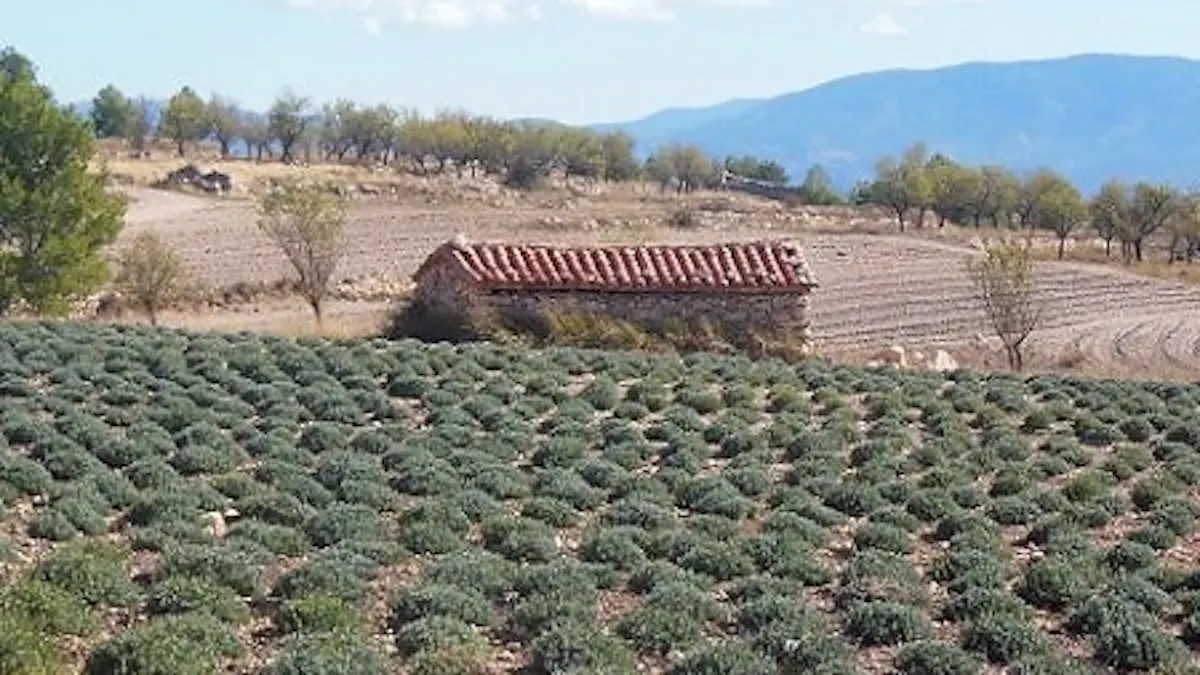
Of course, we didn't miss visiting the high-altitiude fields of Lavandin (with cultivars of Abrialis, Super and Grosso) and Lavandula angustifolia. The most beautiful fields we visited were in Northern Spain where dirt roads descending and rising reach deserted and isolated hills where the silence was broken only by the blowing wind. The harvest was already over and a perfect stillness reigned all around.
Some flowers were left behind after the harvest, while in the far distance we could see decaying buildings and old animal shelters, standing witness to the historical remnants of the once ubiquitous Spanish shepherds.
It is incredible how much the harvest, the yield and the plant’s life is affected by the soil and the land. Here, Lavender plants with no irrigation can last for a maximum of eight years, with the best yields in years [4 and 5]. These plants are so different and shorter lived than those in Bulgarian Lavender fields. As one of our Spanish distiller friends said: “Nature has no standards, only humans do!”.
Footnotes
1 Spain has always been a center of the systematic research on Thyme.
2 This linalool chemotype is predominant in places of high altitude and low temperature.
3 The specific name, serpyllum, is derived from a Greek word meaning to creep (like a snake). It has been given for its way to grow: along the ground without throwing out roots.
4 One of the medieval and classical names of the Origanum Majorana was Amaracum or Sampsucum. Their origin is described in a myth told by Servius Marius Onoratus, a IV century BC Roman literatus : a young perfumer working at the court of King Cinira of Cyprus made a superlative new fragrance. How? He simply fell on the ground while carrying different unguents. From the potpourri of fragrances, a new wonderful perfume arose. Since then the word amaracinum has been used for the finest perfumes. The young perfumer was lately immortalized in a plant: the sampsucum, a synonymous for Marjoram. Le mani degli dei, mitologie e simboli delle pianti officinali nel mito Greco, (The hands of gods, mythologies and symbols of the officinal plants in the ancient Greece). Erika Maderna, Aboca editions 2016. Pag.119 from the chapter: The Perfume of Marjoram.
5 It has large and robust flower spike, twice as long as wide borne on a relatively short peduncle c. 4–8 cm long. Basal fertile bracts are almost circular, the upper fertile bracts are diamond shaped. The stems appear very erect in form. The leaves are large, ovate-lanceolate in shape.