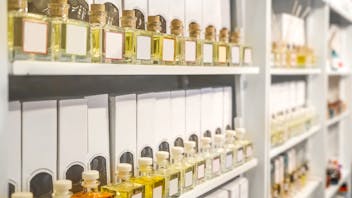
Solubility & Blending Suggestions

  • This product can be applied as a natural perfume as is. It is already diluted for easy use and contains 5% Agarwood Essential Oil in 95% Fractionated Coconut Oil – Organic
  • This dilution is completely soluble in fixed (carrier) oils and not soluble in alcohol.
  • In trace amounts, Agarwood finds "use in perfumery for ... [Amber] bases, woody-aldehydic bases, chypres, fougères, etc."*
  • *Arctander, Steffen. Perfume and Flavor Materials of Natural Origin, 1960, pp. 49-50.

    Suggested Resources

    Agarwood - 5% EO

    Aquilaria crassna Pierre ex Lecomte

    (0)
    $4.00

    Contact us for bulk inquiries.

    Botanical NameAquilaria crassna Pierre ex Lecomte
    Suggested UseAromatherapy, Perfumery, Soapmaking, Candle Crafting
    INCI NameAquillaria Crassna (Agarwood) Wood Oil, Caprylic/Capric Triglyceride
    CAS Number958663-49-5, 73398-61-5
    OriginVietnam
    Extraction MethodSteam Distilled
    CultivationConventional
    Plant Partwood.
    Notebase, fixatives.
    Aroma Familyanimalic, woody.
    Aroma ProfileHighly persistent, sweet, warm, deeply complex, precious woody aroma with shades of smoky, ambery incense, honeyed tobacco, and sensual animalic notes resembling musk/castoreum.
    AppearanceGold-amber, transparent, somewhat viscous liquid.
    Shipping Restriction0 – Non-Hazardous

    Safety Considerations

    • No known contraindications or hazards.* 
    • We recommend that for those with sensitive skin, a patch test should be performed first before use.
    • Store in a cool, dark place away from heat and light.
    • *Tisserand, Robert and Rodney Young. Essential Oil Safety, 2nd ed., 2014, p. 190.

    Agarwood - 5% EO

    Aquilaria crassna Pierre ex Lecomte

    (0)

    Size

    Selected size SKU:58-33 - Agarwood - 5% 1 ml

    $ 4.00
    $4.00
    Details
    Solubility & Blending Suggestions
    Suggested Resources
    Safety Considerations
    Certificates of Analysis (COA)
    Documentation

    Product Overview

    PLEASE NOTE: we are unable to ship this product internationally due to CITES regulations.

    Agarwood essential oil has a highly persistent sweet warmth and a deeply complex, precious and magnificent woody aroma with shades of smoky, ambery incense, honeyed tobacco, and sensuously underscored with animalic notes resembling musk/castoreum. The aroma becomes sweeter and musky/woody in the very long drydown. NOTE: This product is diluted for ease of use and contains 5% Agarwood essential oil in 95% Fractionated Coconut Oil – Organic. For the pure and undiluted version of this oil, please see our Agarwood essential oil.

    Originally from Southeast Asia[1], Agarwood formed the basis of the legendary Arabian perfume called Oud.[2] It is also known as Aloeswood, Eaglewood, Kyara, Ood, or Ud, and many other names, depending on the wood's grade and country of origin.[3] Revered and esteemed by many cultures, Agarwood is a highly valued addition to the natural perfumer's palette and is often used in sacred oil blends and for ceremonial anointing. Kurt Schnaubelt writes that "…[Agarwood oils] evoke mental or spiritual reflection and a rekindled sense of awe for the phenomena of nature."[4]

    Agarwood essential oil is procured by distilling the heartwood of the genus Aquilaria, a flowering tree with various species that grow in Cambodia, Laos, Thailand, Vietnam (A. crassna); the Philippines (A. filaria); and northeastern India, Burma, Malaysia, Sumatra, Borneo (A. agallocha), but only those trees that have been infected by a parasitic fungus (Phialophora parasitica and others) are the source of this rare and highly prized material.[5] In response to the infection, the trees attack the affected wood by producing an oleoresin that, after some years, becomes dark and highly aromatic. The oleoresin accumulates to such an extent that the bulk and density of the infected wood causes it to sink in water, thus the Japanese call it jinkoh – 'wood that sinks' and in China it is called ch'en hsiang – the 'sinking incense wood.'[6] It is the incense industry that accounts for the main commercial use of Agarwood[7] – it is one of the oldest and most famous incense materials of the Far East.[8]

    This product is diluted for ease of use and contains 5% Agarwood essential oil in 95% Fractionated Coconut Oil – Organic. For the pure and undiluted version of this oil, please see our Agarwood essential oil.

    PLEASE NOTE: The trees from which we source our Agarwood essential oil are from a forest in Vietnam where they are sustainably harvested and periodically replanted. They are inoculated by hand when they reach 10 years of age; after the infection has been allowed to propagate for 2 years, the trees are harvested for distillation.[9] We also have on hand the CITES certification that notes this product was legally imported and cleared by the US Fish and Wildlife Service.

    1 Lawless, Alec. Artisan Perfumery or Being Led by the Nose, 2009, pp. 2, 44.

    2 Ibid, p. 44.

    3 Rhind, Jennifer Peace. Fragrance and Wellbeing, 2014, pp. 157-8.

    4 Schnaubelt, Kurt. "Oils from the East" (distributed booklet), 8th International Aromatherapy Conference, San Francisco, California), Nov. 6-8, 2015.

    5 Rhind, Jennifer Peace. Fragrance and Wellbeing, 2014, pp. 157-9.

    6 Ibid, p. 158.

    7 Ibid, p. 159.

    8 http://www.bojensen.net/EssentialOilsEng/EssentialOils01/ EssentiaOils01.htm#Agarwood

    9 Industry communication.
    Product Overview

    PLEASE NOTE: we are unable to ship this product internationally due to CITES regulations.

    Agarwood essential oil has a highly persistent sweet warmth and a deeply complex, precious and magnificent woody aroma with shades of smoky, ambery incense, honeyed tobacco, and sensuously underscored with animalic notes resembling musk/castoreum. The aroma becomes sweeter and musky/woody in the very long drydown. NOTE: This product is diluted for ease of use and contains 5% Agarwood essential oil in 95% Fractionated Coconut Oil – Organic. For the pure and undiluted version of this oil, please see our Agarwood essential oil.

    Originally from Southeast Asia[1], Agarwood formed the basis of the legendary Arabian perfume called Oud.[2] It is also known as Aloeswood, Eaglewood, Kyara, Ood, or Ud, and many other names, depending on the wood's grade and country of origin.[3] Revered and esteemed by many cultures, Agarwood is a highly valued addition to the natural perfumer's palette and is often used in sacred oil blends and for ceremonial anointing. Kurt Schnaubelt writes that "…[Agarwood oils] evoke mental or spiritual reflection and a rekindled sense of awe for the phenomena of nature."[4]

    Agarwood essential oil is procured by distilling the heartwood of the genus Aquilaria, a flowering tree with various species that grow in Cambodia, Laos, Thailand, Vietnam (A. crassna); the Philippines (A. filaria); and northeastern India, Burma, Malaysia, Sumatra, Borneo (A. agallocha), but only those trees that have been infected by a parasitic fungus (Phialophora parasitica and others) are the source of this rare and highly prized material.[5] In response to the infection, the trees attack the affected wood by producing an oleoresin that, after some years, becomes dark and highly aromatic. The oleoresin accumulates to such an extent that the bulk and density of the infected wood causes it to sink in water, thus the Japanese call it jinkoh – 'wood that sinks' and in China it is called ch'en hsiang – the 'sinking incense wood.'[6] It is the incense industry that accounts for the main commercial use of Agarwood[7] – it is one of the oldest and most famous incense materials of the Far East.[8]

    This product is diluted for ease of use and contains 5% Agarwood essential oil in 95% Fractionated Coconut Oil – Organic. For the pure and undiluted version of this oil, please see our Agarwood essential oil.

    PLEASE NOTE: The trees from which we source our Agarwood essential oil are from a forest in Vietnam where they are sustainably harvested and periodically replanted. They are inoculated by hand when they reach 10 years of age; after the infection has been allowed to propagate for 2 years, the trees are harvested for distillation.[9] We also have on hand the CITES certification that notes this product was legally imported and cleared by the US Fish and Wildlife Service.

    1 Lawless, Alec. Artisan Perfumery or Being Led by the Nose, 2009, pp. 2, 44.

    2 Ibid, p. 44.

    3 Rhind, Jennifer Peace. Fragrance and Wellbeing, 2014, pp. 157-8.

    4 Schnaubelt, Kurt. "Oils from the East" (distributed booklet), 8th International Aromatherapy Conference, San Francisco, California), Nov. 6-8, 2015.

    5 Rhind, Jennifer Peace. Fragrance and Wellbeing, 2014, pp. 157-9.

    6 Ibid, p. 158.

    7 Ibid, p. 159.

    8 http://www.bojensen.net/EssentialOilsEng/EssentialOils01/ EssentiaOils01.htm#Agarwood

    9 Industry communication.
    Blends Well With

    logo

    2025-10-17

    Animalic Aromas – Notes of Warmth, Leather, and Musk

    Have you ever wondered what perfumers mean when they describe a scent as ‘animalic’? In perfumery, the Animalic aroma family refers to essences that evoke the warmth and intimacy of living beings – notes that are musky, leathery, sensual, and sometimes just a touch ‘dirty.’

    logo

    2025-09-19

    Tracing the Scent – A Journey to Sustainable Agarwood

    Agarwood essential oil is one of perfumery’s most rare and coveted natural materials. Known for its multi-dimensional depth, complexity, and tenacity, Agarwood’s unique, sweet, warm woody aroma brings luxurious richness and intrigue to high-end and niche fragrances.

    logo

    Natural Perfumery Basics

    One of the most common ways to formulate a personal fragrance is by composing a balance of aromatic oils using three different categories based on oil evaporation (volatility) rates: Top, Middle and Base Notes.