10 min read
2017-02-24
Interview with Anya McCoy
Written By: Angela Gembrin
Anya McCoy is one of the pioneers of modern Natural Perfumery, founder of the Natural Perfumers Guild as well as the Natural Perfumery Institute. In addition to being a pillar in the Natural Perfumery community, Anya is a perfume gardener and amazing perfumery instructor with a college-level course. Eden Botanicals is so thankful to have a long lasting collaboration with this award-winning artisan.
Can you tell us a little about your background? In particular, what led you to become a Natural Perfumer rather than a more ‘traditional’ Perfumer who utilizes synthetics?
When I was 15, friends of the family brought me some sandalwood oil from India, knowing how I loved perfume. Then hippie stores opened, selling patchouli, frankincense and other oils. I collected many oils for the next decade. In 1975 two retired perfume salesmen I knew gave me two of their old sales kits. They also turned me on to William Kaufman’s book “Perfume” with some basic instructions on how to evaluate oils properly, and systematic examples how to blend accords. That was it, I was hooked, and determined to make 100% natural perfumes from my stash of oils. I bought from Caswell Massey, Aphrodesia (NYC), Penn Herb and a few other sources at that time (mid 70s). In 1976 or so, another source was a shop in Westlake (LA) called the Magic Dragon. At any given time, one of the four owners were in India, buying oils at the source. I made friends with them, and we had marathon “sniffing” sessions at the store.
I received my degree in Economic Botany from the University of California, Riverside, specializing in fragrant plants. In the early 80s, I noticed that mainstream perfumes were now much more aggressive and irritating to the respiratory system, causing many people to have physical complaints. This only further cemented my decision to blend natural perfumes, which are gentle, historical, and without modern laboratory manipulation.
In 1991 I launched my first line of natural perfumes “Anya’s Tropical Essences” and they were sold in a number of retail stores in the Miami area. Hoteliers on South Beach commissioned me for private label fragrances for their hotel soaps, lotions, shampoos, etc. Most of the hoteliers were European, and they appreciated natural fragrances. They also referred many of their guests to me for custom scents, and I continued Anya’s Tropical Essences until 2005 when I launched a high-end line of natural perfumes as Anya’s Garden Perfumes. I am 100% committed to only natural extracts, including essential oils, absolutes, concretes, CO2, tinctures and enfleurages because the natural essences speak volumes to me, connecting me to the history of healing, sensuality, and delight.
Are you able to tell us a little about your creative process when it comes to creating your formulations?
I’m typically inspired by a particular aromatic, and then I form a “perfume brief” for it in my head. Sometimes I am inspired by a garden or literary character, such as Fairchild Botanic Garden, or Kewra and Pan from the book Jitterbug Perfume. A brief is an explanatory tool, you might call it a story, that helps expand and explain the focus of the perfume I wish to create. Perfume does tell a story, and it must be cohesive, and focused. Is the aromatic to be bold and assertive, or shy and seductive, and what are the aromatics that are needed to support and elevate this story? With a trained scent memory, the methodology of which I teach in my courses, I’m able to select an array of aromatics that I believe will work with the story. Now the testing, creating modifications of those aromatics in different ratios, begins.
I’m a natural extrovert, but perfume making requires quiet, contemplative focus, and a bit of an introverted mindset. It’s like building a clock, or another detailed process. Does a jeweler who is placing precious jewels in a setting, or someone embroidering a delicate cloth have distracting conversation or loud music playing? No. I work in a quiet, serene setting because it is needed for the artful task at hand.

We know that you are an avid gardener and grow some of the more tropical essential oil bearing plants such as Ylang Ylang. Do you ever distill or extract your own plants for use in perfumery?
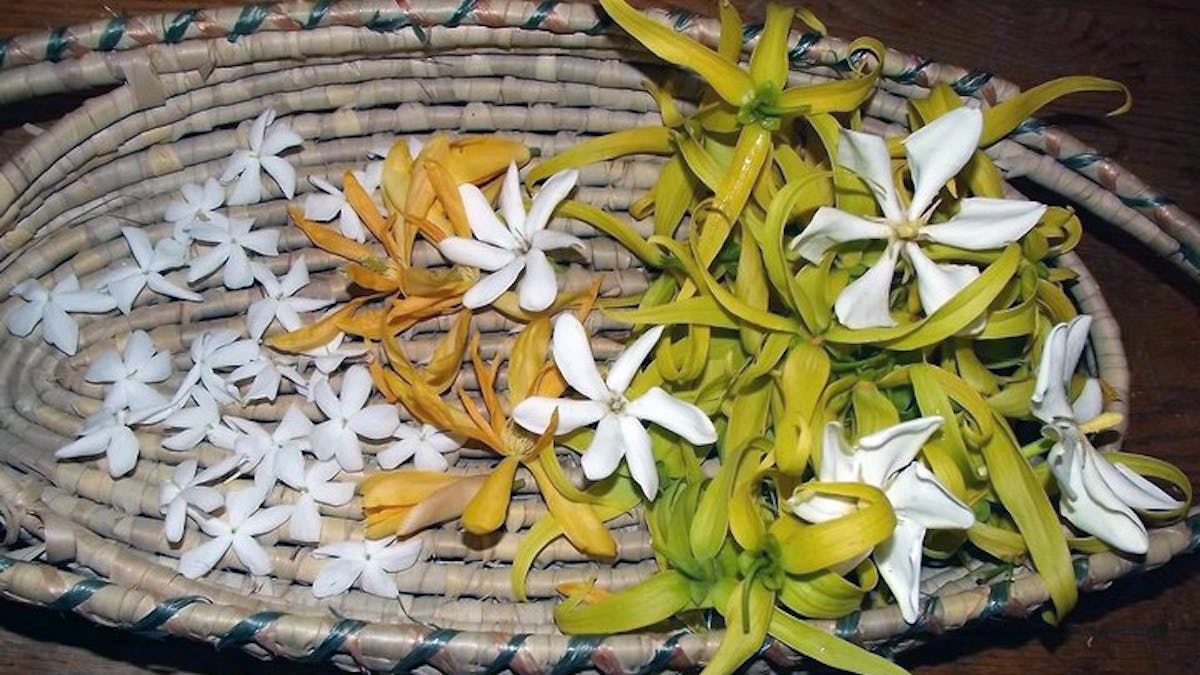
I have a very large collection of tinctures, and also pomades made in the enfleurage process. Right now, in the “dead” of winter for most of the Northern Hemisphere, my garden is fragrant with ylang ylang flowers, various jasmines, a relative of lemon verbena that smells like almonds and cherries, Michelia alba, and night blooming jasmine (cestrum). I harvest from early morning to night, since some are only scented at night. I have distilled a new plant for natural perfumery, Cornutia grandifolia, with huge, velvety scented leaves that have a mélange of notes, from tobacco to amber to mint. I’ve only gotten hydrosol for now, distillation can take a lot of experimentation to get an essential oil yield. Growing and extracting essences are my daily passion and I am currently writing a book Perfume From Your Garden that will instruct the reader on how to extract the scent from roots, wood, leaves, seeds, and flowers.
You are the first Artisan Natural Perfumer to be inducted into the American Society of Perfumers. Can you tell us about this groundbreaking experience and what it means to you?
When the president of the American Society of Perfumers wrote me, saying she wanted to nominate me for full membership, I was stunned because I didn’t know I was on their radar. In existence for almost 70 years, they had never had a natural perfumer, an artisan perfumer, in their ranks. Their membership is mostly perfumers who work for the big houses or for companies who create functional perfumery products. You have to have twenty years in the business and be nominated by a full member to be considered. The vetting process is quite comprehensive, and I’m delighted that I made the grade. I am now able to nominate other artisan perfumers who have the experience and that is wonderful.
You are the President of the Natural Perfumers Guild. Can you describe what the guild is, its purpose, as well as the benefits of joining?
The Guild is the only international organization dedicated to 100% natural perfume. Our mission is to gather, strengthen and empower our existing member community, increase public awareness through education about pure and natural perfumes, and establish standards of excellence in perfumery by protecting the traditional art of perfumery through ethical standards. Our membership includes Friends (those who do not have a business), Certified Natural Perfumers, Associates, and Suppliers.
The Guild also addresses legislative issues that affect natural perfumery. Our Code defines the elements that make us a self-regulating organization. Our standards for our Certified Natural Perfumers are the highest in the world regarding the use of natural ingredients. For the Guild definition on natural aromatics, please visit http://www.naturalperfumers.com/definition.php
Members join for a variety of reasons: to find a like-minded community and to enjoy a forum where ideas can be exchanged, to obtain a library of vintage perfumery books in .pdf format, to be listed on our website where members of the general public can find them when searching for natural perfume, as we have a high search engine rating, and so many more I can’t list them.
Does the Guild have specific guidelines in regards to ingredients? What are your personal thoughts on Natural Isolates? It seems that the when it comes to Isolates, the line between Natural and Synthetic can get blurred.
My answer to the previous question shows the Guild definition of natural aromatics. A bit later, the Guild membership voted for a very strict definition on natural isolates. Yes, there is much confusion about them, but if someone were to follow our guidelines, they would have no problem labeling their perfume natural. Besides synthetic isolates that have been around for generations, there is a new type of product flooding the market, from isolates made from parent material not related to what you think you’re buying, such as “vanillin” made from rotted wood, to even worse, vanillin made from GMO microorganisms fermented/created in the lab. To find the Guild definition of a natural isolate, please visit http://anyasgarden.com/blog/natural-isolates-and-the-natural-perfumer-being-the-captain-of-your-own-fragrant-ship/ I posted this on my blog so I could open up discussion with the general public. It’s is quite lengthy, and there is a list of natural isolates there.
How did you begin teaching Natural Perfumery?
In 2002, I started a discussion group for natural perfumery on Yahoo. The emphasis was on education, not a chat room set up, which many Yahoo groups were at the time. All the conversations are archived there, along with Files, Links, etc. In 2006, members of the group kept asking me to establish a more formal educational format for them, because as helpful as the group was/is, they wanted me to share my decades of experience as a natural perfumer in a “classroom” setting, with a syllabus, text, and supporting materials. So, in September 2007, I launched the first online natural perfumery course for students. No matter where in the world, they were able to use the primer and website materials and forum for their formalized studies.
Your school, the Natural Perfumery Institute, offers a highly in depth correspondence course on Natural Perfumery. Can you tell us about your course and what makes it so unique?
In 2010, the coursework was compiled into a textbook, the first of its kind in the USA. The 350-page textbook is supplemented by many evaluation and recording forms, charts and supplemental documents in both Word.doc and Excel.xls forms, so they can update and search for their findings when they evaluate, begin constructing accords, through the final perfume.
The book includes groundbreaking – for artisan perfumers, corporate perfumers have used these money- and time-saving techniques for decades – ways to dilute aromatics for evaluation, systematic step-by-step clear instructions on every technique and process, including building horizontal and vertical accords, making modifications, and the final perfume.
The book contains a truly professional angle for students, and I introduce them to many terms used in the big houses, such as millefleurs, louching, and others. Detailed descriptions of aromatic groups, fragrance families, extraction methods and regulations are covered. It’s very comprehensive because I want my students to be able to hold their own in a conversation with a perfumer from anywhere in the world, who may have been trained in a formal perfumery school/corporation, and know that they are on equal footing.
As students receive certification of completing the course, they are able to move on to the Intermediate Level, and then, the Graduate Level. All of the Levels are aimed at giving the student cumulative knowledge of how to make perfumes. I have several students, for instance, who work in labs, including a perfume lab in Lithuania, and they say they learned a lot about laboratory equipment being used in perfumery in the Intermediate Level. I love gadgets for measuring quantitative and qualitative results, so using scales and measuring total dissolved solids with a meter is a fun and rewarding exercise that the students learn. At the Graduate Level, I work with them to use the techniques and finesse their skills and understanding of perfumery to the highest level.
Is any experience required for students interested in taking your course?
A basic understanding of English helps, but is not mandatory. My editor worked for Microsoft and Boeing, writing technical manuals for their foreign engineers, most of whom only had a rudimentary knowledge of English. I have students from Saudi Arabia, Mongolia, Israel, Afghanistan, Mexico, Brazil, France, Italy, and many other countries, and they are all doing well, or have graduated. If there is difficulty of some sort, they can post in the student forum and either myself, a faculty member, or another student steps in to help clarify the issue.
I have had students as young as 20, and several senior citizens with no science, math, or other technical background complete the course with no problem. It is gratifying to know the textbook and the supplemental materials work with everyone.
What types of students does your class attract? Are many of your students already involved in aromatherapy and natural perfumers looking for more formal training?
I have students with incredibly varied backgrounds enroll. Yes, some aromatherapists and natural perfumers, including award-winning perfumers who want to learn my methods, but chemical engineers, soap makers, authors, spa and esthetician workers, stay-at-home moms, and medical doctors and acupuncturists are also part of the student body. So, to answer your question – it’s a cross-section of folks, from all walks of life.
You state that your “coursework is based on the methods and techniques of French perfumery schools,” can you tell us a little more about this?
Decades ago, there were NO perfumery schools. Several great perfumers, including Edmond Roudnitska and Jean Carles developed a method of evaluating and constructing perfumes. No knowledge of chemistry is needed to learn perfumery, according to these greats. By carefully training your nose to have a great scent memory, by trial-and-error evaluations and recordkeeping, you will learn what happens when the chemical properties of raw aromatics interact. It was a thoughtful and time-proven concept and what I found in that book by Kaufman four decades ago. I refined it for natural perfumery, but anyone interested in learning perfumery, even if you use synthetics, can benefit from the methods in this course.
Do you include the history Natural Perfumery in your coursework?
Yes! There is a beautiful, subconscious, emotional link to our ancestors who used only natural aromatics. From prehistoric times, people were drawn to the fragrant beauties in the landscape, and generation after generation passed down the skills. Our grannies may have distilled, or made, or bought, simple preparations like Florida water, rose water and other scented delights to make the day a little more enjoyable. Then synthetics were introduced in the 19th century, and much of natural perfumery was forgotten in the Western world, not so much the Eastern. I delight in bringing that history to the students, and helping revive this art which languished for about 150 years. The students know, in context, they are the new generation and that the art is now revived, hopefully for eternity.
What do you think is the most important thing that students take away from your course?
That they have confidence to create, and evaluate their perfumes. They have a solid foundation that allows them to experiment, improvise, and move forward in the perfumery world. I want them to understand that the study of perfumery is a lifelong effort, and there are no short cuts, no “quickie” ways to learn. 'Slow Study' is our motto.
How many of your students go on to start their own Natural Perfumery business after studying with you?
I never kept records, but I would say 40-50%.
Do you have any words of advice for budding Natural Perfumers and those new to Natural Perfumery?
Research all your suppliers, quiz them, interact with other natural perfumers, and never stop exploring, never let your imagination be stifled by convention.
(All photos courtesty of Anya McCoy)